Comparisons & Buying Guides
Rowing Footrest Comparison: Adjustability Impacts Performance
4th Apr•9 min read
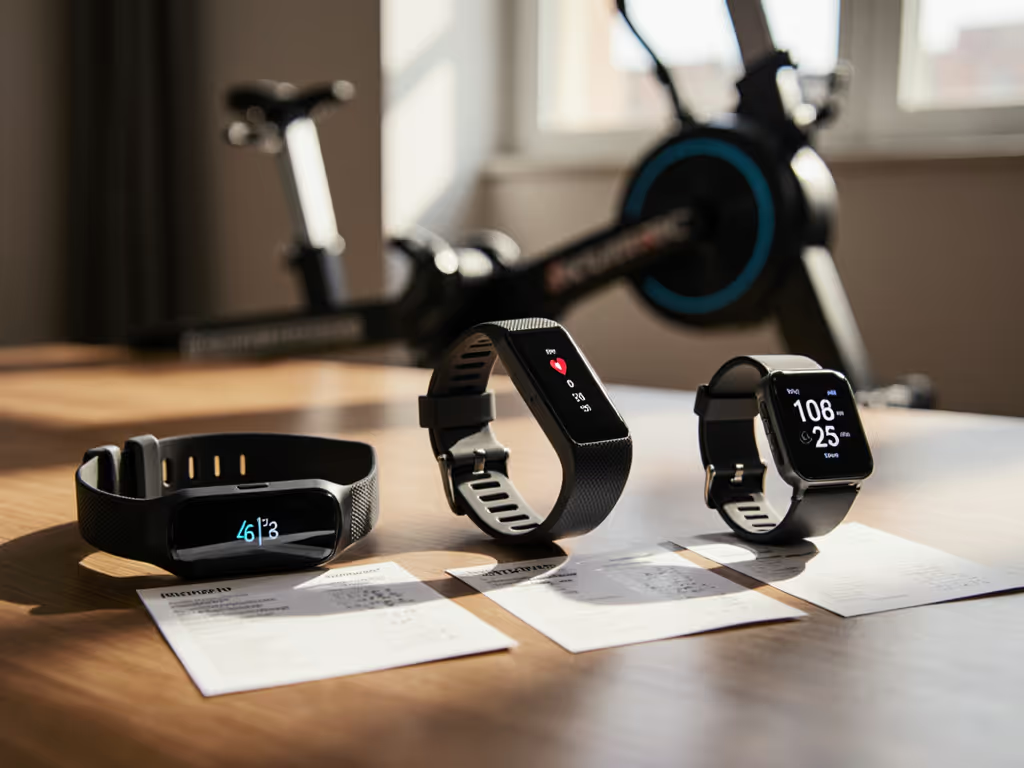
Choosing the right rowing machine heart rate monitor requires balancing accuracy, durability, and long-term cost (not just the upfront price tag). Whether you're pairing a smart rowing machine with an external HR sensor or relying on built-in monitoring, the gap between a reliable signal and a misleading one shapes your entire training picture. This comparison cuts through marketing noise to show you what actually works on the water, and why TCO math matters more than MSRP.
Your rower logs watts; your heart rate logs effort. For a deeper dive into HR, VO2, and recovery metrics, see our rowing biometrics guide. One tells you power output, the other reveals how hard your cardiovascular system is working to produce it. For most home rowers, heart rate serves as a proxy for aerobic load and recovery tracking (training zones for easy base-building, tempo work, and high-intensity intervals). Accurate data means you trust your zones; noisy data means you second-guess every row.
Unlike running on a flat treadmill, rowing demands total-body coordination and sustained upper-body tension. This matters for sensor placement: wrist-based monitors struggle because arm movement during the drive phase creates cadence-lock errors (the watch confuses your stroke rate for heart rate)[1]. Arm bands and chest straps avoid this problem, but not equally.
Technology: A thin electrode band worn snug across the ribs detects electrical signals from your heart. No light source, no movement ambiguity.
Accuracy on the rower: Exceptional, even during sprint intervals. Chest straps maintain high accuracy as intensity picks up, a critical advantage for rowing's explosive power demands[2]. Studies confirm optical sensors become less reliable during high-intensity exercise; chest straps do not[2].
Popular models: Polar H10 (gold standard, long battery life, coin-cell powered), Garmin HRM-600 (rechargeable, ANT+ and Bluetooth, water-resistant to 50 meters)[2].
Downsides: Requires a snug, consistent fit. Some users report mild chafing after 45+ minutes. Battery-dependent (though 12+ months for coin-cell types).
Resale & durability: Chest straps are tough, with no complex optics and simple electrode contacts. Used units trade easily on secondhand markets; depreciation curves are gentle because demand stays steady. For big-picture economics, see which machines hold value in our rower resale value analysis.
Technology: Light-based PPG (photoplethysmography) sensor detects changes in blood volume under the skin. Worn on the bicep or forearm.
Accuracy on the rower: Good on land, with a caveat. Optical armbands show similar accuracy to chest straps during steady-state rowing[1]. However, rapid heart rate spikes (sprint finishes, max-effort intervals) expose a 1-2 second lag and slightly lower reliability than chest straps[1]. Water degrades performance; underwater accuracy is noticeably less reliable[1].
The win: placement higher on the arm (bicep vs. forearm) reduces movement artifact. A rower's arm position during recovery is stable, which helps, but the catch and drive still create micro-shifts that optical sensors register as noise[2].
Popular models: Polar Verity Sense (armband or clip-to-goggles for swim mode, rechargeable, 600+ hours of internal storage), COROS Heart Rate Monitor (armbands, up to 38 hours battery, three simultaneous device connections)[1].
Downsides: Moisture-sensitive. Sweat buildup can reduce accuracy. Rechargeable batteries add complexity (and planned obsolescence after 3-5 years).
Resale & durability: Optical sensors are consumer electronics; reliability drops after heavy use. Internal memory becomes a selling point for secondhand buyers. Battery replacement is often not user-serviceable, a TCO liability.
Technology: Smartwatch or fitness tracker with optical HR sensor on the wrist. Same PPG method as armbands, wrong location.
Accuracy on the rower: Poor. The wrist moves constantly during the drive and recovery, with rotation, flexion, and tension changes. Cadence lock is real: your Apple Watch or Garmin smartwatch can misread your 30-32 strokes-per-minute rhythm as a 170+ BPM heart rate[1]. Even premium watches diverted significantly from chest-strap baselines in comparative testing[1].
Anecdotally, some rowers report Apple Watch readings being oddly accurate (within 1-2 beats of a chest strap)[3], likely due to individual physiology and how snugly the band sits. But this is exception, not rule. User error often matters: too loose a band, too much wrist roll, tattoos, or darker skin tones all degrade optical sensors[3].
Popular models: Apple Watch Series 9+, Garmin Epix/AMOLED, COROS Apex Pro 2. Many ship with built-in rower apps (Apple Fitness+, Garmin Coach, etc.)
Downsides: Locked into the watch ecosystem. Recurring app fees ($10-$15/month for premium coaching). Wrist-based HR data generally flows one-way into the brand's app, with poor interop with Strava, Garmin Connect (if you use a non-Garmin watch), or Apple Health without manual export friction.
Resale & durability: Smartwatches depreciate steeply. A $400 Apple Watch from 2023 sells for $150-$200 used. Software updates can break compatibility. Repair is rarely worth it.
REI's 2026 expert testing of six monitors revealed:[1]
For rowing, "in water" is your entire session. The rower sits near water splashes, humidity is high, and if you wipe your device with a damp towel mid-row, optical sensors suffer. Chest straps are inherently water-resistant; armbands are not[2].
Aliyah's Craigslist rower taught a hard lesson: pay once, maintain forever. A $400 monitor with dead internals after 3 years costs you $133/year. A $150 used chest strap that works for 8 years costs $19/year.
Break it down:
Chest straps use coin-cell batteries (Polar H10, 12-14 months per battery, $5-$8 to replace). No subscription. Paired with Garmin, Suunto, Strava, or Polar's own apps, and free tier options exist[2]. Resale value holds because the form factor hasn't changed much in a decade.
Armbands require rechargeable batteries. After 300-500 charge cycles (2-4 years), capacity drops 20%. Replacement often means a new device ($100-$150)[1]. Internal memory is a feature only three-of-six monitors tested offer, but when it does, you buy once and never lose a session[1].
Smartwatches lock you into ecosystem lock-in. Apple Watch repairs run $200+; replacement is $300+. After 4-5 years, you're pressured to upgrade. Resale is poor. Subscription apps ($10-$45/month) tack on $120-$540 annually.
Your rower's app may display HR, but your training truth lives in Apple Health, Garmin Connect, or Strava. Cross-platform compatibility is non-negotiable for small-space athletes who value autonomy. If data openness matters, check our data freedom rowers comparison to avoid ecosystem lock-in.
Best choice: Chest strap (Polar H10 or Garmin HRM-600). You need unflinching accuracy during power transients. The 1-2 second lag on armbands is invisible during 5-minute steady efforts but glaring in 30-60 second sprints. Internal memory (H10's coin-cell lasts 12+ months) lets you row offline and sync later, valuable if your Wi-Fi cuts out or your app crashes.
TCO: ~$80-$150 upfront. Coin-cell or one rechargeable battery over 5 years. No subscription. Resale: 60-70% of purchase price.
Best choice: Armband (Polar Verity Sense or COROS). Accuracy is good enough for easy paces and tempo rows. The optical sensor doesn't matter as much when heart rate is stable. Battery life is longer (up to 38+ hours)[1], so you row multiple times without recharging. Rechargeable battery removes the consumable cost, but plan for replacement in 3-4 years.
TCO: ~$100-$150 upfront. Battery replacement ~$50-$80 in year 3-4. No subscription. Resale: 40-50% of purchase price.
Caveat first: Wrist-based HR is unreliable on the rower. If you accept that and just want a general indicator (zones only, not splits), then your watch works as a "good enough" free option. Sync to Apple Fitness+ for guided sessions. But don't build a training plan around wrist HR data alone.
Better option: Pair your Apple Watch with a Bluetooth chest strap (H10, HRM-600, or a third-party brand). The watch becomes the display and data hub; the strap provides truth. Cost: watch (you have it) + strap ($80-$150).
TCO: Already spent on watch. + $80-$150 strap. Resale: Watch depreciates steeply; strap holds value.
A monitor isn't just a purchase; it's a system.
Chest straps: Electrode wear is the main failure mode (degraded contact = weak signal). Replacement straps are cheap (~$20-$30). Some users report the strap loosening over 2+ years; tightening the velcro or buying a replacement band (not a new device) solves this. Coin-cell batteries are user-replaceable on most models. Failure rate is low; repair path is clear.
Armbands: Battery swelling, optical lens fogging or scratching, and water ingress are failure modes. Few armbands accept user-replaceable batteries. Once the rechargeable is dead, you buy a new unit. Failure is often terminal.
Smartwatches: Accelerated obsolescence. Software updates stop after 4-5 years. Battery degradation is normal. Repair is expensive. Resale suffers; upgrade pressure is high.
For a small-space rower athlete who values accuracy, durability, and long-haul value:
Best overall: Polar H10 chest strap. Proven accuracy, coin-cell battery (user-replaceable, <$10), open ecosystem, minimal maintenance. $80-$100. Over 10 years, cost per reliable session drops well below a studio class.
Best upgrade (if you want rechargeable + internal memory): Polar Verity Sense armband. Multisport versatility, 600+ hours of internal storage (no cloud required), solid accuracy on land. $150-$170. Expect battery replacement in year 3-4 (~$70), shifting your 5-year TCO to ~$220 vs. H10's ~$120.
Avoid: Relying solely on a smartwatch for rowing HR. Acceptable as a display if paired with a chest strap; otherwise, you're paying for a $300-$500 device and accepting mediocre rowing data. Resale hit is steep; ecosystem lock-in is real.
The math is simple: Pay once for durability and service clarity. Maintain with cheap consumables (batteries, straps). Your rower pays you back. That ledger (tracking sessions, cost-per-workout, parts swaps) reveals real value in a way a price tag never can.